Human Rights
Human Rights (M.A.)
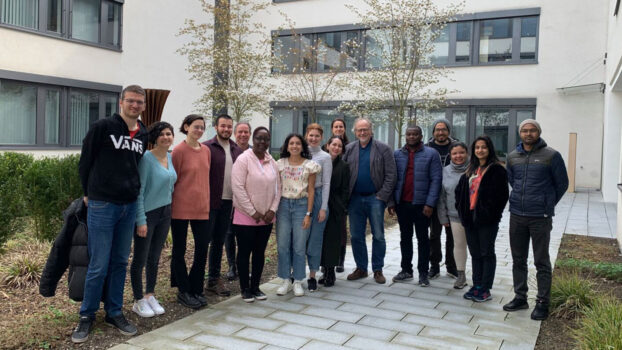
Do you have a passion for human rights? With the Master’s degree program in Human Rights, you can expand your knowledge and open up more career opportunities. No matter whether your interest stems from courses you took in your undergraduate program or from practical experience in human rights work, this degree program will offer you an international perspective and a wide range of career opportunities. Apply now and start your journey into the exciting world of human rights work.
Please note: The information on this page applies to students beginning the program in the winter semester 2026/27 or later.
- Degree
- Master of Arts (M.A.)
- Duration of studies in semester
- 4
- Start of degree program
- Winter semester
- Study location
- Erlangen, Nuremberg
- Number of students
- 1-50
- Subject group
- Economic and Social Sciences, Law
- Special ways to study
- International degree program, Part-time degree program
- Teaching language
- completely in English
- Admission Requirements
- Qualification assessment
- Keywords
- Abroad, Society, International, Legal, Human Rights, Public Law, Politics And Society
What is the degree program about?
The interdisciplinary, English-taught M.A. in Human Rights is aimed at national and international applicants with a Bachelor’s degree in the legal sciences, social sciences or humanities, and a passion for human rights, ideally rooted in previous experience in that area.
-
The course program of the M.A. Human Rights covers fundamental challenges as well as current issues of human rights worldwide. It pursues an interdisciplinary approach by considering the political, philosophical and legal dimensions of human rights.
The program consists of 120 ECTS credit points. Students can choose between completing the program full-time in two years (four semesters) or part-time in four years (eight semesters). Those studying full-time are expected to complete a course load of 30 ECTS per semester or 60 ECTS per year. The course load for part-time study is 15 ECTS on average per semester and not more than 35 ECTS per year.
In the first semester, all full-time students will enrol in compulsory modules covering political, philosophical and legal foundations of human rights. In the second semester, students will participate in a mandatory, interdisciplinary module on non-discrimination and elect four out of a variety of specialized modules that may cover topics such as Business and Human Rights, International Criminal Law, Transitional Justice, Migration and Human Rights, Human Rights Philosophy, and International Organizations. These courses will be complemented by a one-year-long seminar on Current Issues in Human Rights. The third semester focuses on modules covering methodological skills as well as soft skills for human rights work. The program is complemented by elective modules that will allow students to choose from a wide selection of complementary and language courses. In the fourth semester, students will be able to choose between two options to finish their degree: Either write one in-depth scientific thesis or combine a shorter thesis with a mandatory internship.
Students choosing to study the program part-time will take the same courses but spread them out over the course of eight semesters instead of four.
-
- Admission requirements (first semester)
- Qualification assessment
- Application deadline winter semester
-
31.05.
- Content-related admission requirements
-
- A first university degree based on at least 3 years of full-time studies (equivalent to 180 ECTS credits)
- Successful completion of the assessment process as outlined in the program rules
- Proof of English language skills in line with level C1 CEFR (for guidance on the respective test results, please see this overview)
Further information on the admission requirements can be found on the program website.
Language skills
- German language skills for international applicants
- No DSH
- General language skills
-
Proof of proficiency in English
Students must prove proficiency in English equivalent to level C1 of the Common European Framework of Reference for Languages. This means that students are required to show that they have completed a recognized language test such as IELTS, TOEFL, UNIcert, Cambridge etc.
- Details and notes
-
You will be required to submit the following documents:
- CV in tabular form
- Certified copies of your previous university degree(s), including transcript(s) of records and, if available, diploma supplement(s). Please see the university website for instructions on the required certification.
- Official translation of all your academic documents if they are not originally issued in English, German or French.
- Certified copy of your school leaving certificate and an official translation if it is not in English, German or French.
- Proof of English language skills.
- A short application essay (appr. 2 pages) guided by the following questions:
- Describe and reflect on a human rights project that you completed during or outside of your studies.
- Describe a specific instance of a human rights violation and explain why you think this constitutes a human rights violation.
- What do you think is the biggest human rights issue in your country? Why?
- Where applicable: Proof of your professional or voluntary experiences in the area of human rights together with a description of your duties.
- Applicants from China, India and Vietnam also need to upload their APS certificate.
Further information on the application process is available on the program website.
Do you need help or more information?
Our Student Advice and Career Service (IBZ) is the central point of contact for all questions about studying and starting a degree programme. Our Student Service Centres and subject advisors support you in planning your studies.